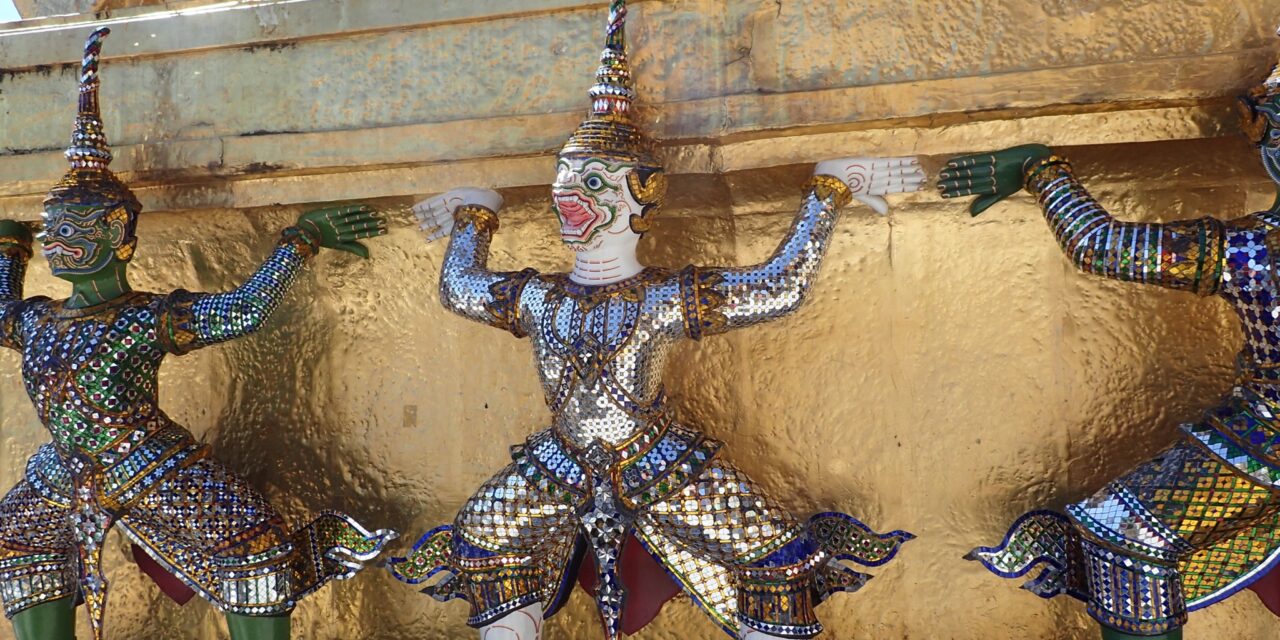
Demons ‘supporting’ one of the guilded chedis (pagodas) that flank the Royal Pantheon.
After our diving trip on the Liveaboard Aggressor we had a couple of days booked at the airport hotel in Bangkok before returning back to Japan and packing up to return to the UK. Unfortunately Mike suffered from a bad bout of ‘Delhi Belly’ which limited our planned sightseeing adventures. However, we still managed to visit the Grand Palace and spend a few hours wandering around first thing in the morning before it got too busy and when the light was perfect for taking photos.
The Grand Palace is a complex of buildings which were started in 1782 by King Rama 1. Having seized the crown he wanted to build a capital city for his new Chakri Dynasty, so he moved the capital of Thailand to this location. A lot of the materials for the buildings were ‘recycled’ from the old capital city which had been destroyed in a 1767 during a war with Burma. The complex formed Thailand’s religious and administrative centre until 1925. Now it is primarily a ceremonial site and tourist attraction
Below are some photos of the entrance to the palace complex together with the demon guards and other protective demon statues we enjoyed looking at. The demons at the entrance are one of the 6 pairs of the demon guardians. Most of the guardians are facing to the chapel of the Emerald Buddha. Their intent is to protect the Emerald Buddha from evil spirits.
Murals on walls surrounding the Emerald Buddha Temple.
The next set of photos are some of the murals on the walls surrounding the Emerald Buddha temple, (Thailand’s most sacred site). These were first painted in 1783 and have subsequently been restored 4 times. They depict the story of the Ramakien, a classic story about the battle of good versus evil. The murals are painted on 178 panels each depicting a scene from the story. All together the murals span a length of more than two kilometers. Just being able to see these in person made the visit. They are absolutely fantastic.
link to schematic of the Grand Palace. As well a link to more information about the history and architecture of the various buildings more info link
Royal Pantheon link to info
This building now enshrines eight life sized statues of each of the kings of the Chakri Dynasty. Originally it was designed to be the chapel to house the Emerald Buddha but was deemed too small. Roof of the Pantheon has a distinctive corn-cob shaped tower called a prang. The golden spire of the temple of the Emerald Buddha is to the left. On the right is one of two of the gilded chedis flanking the Pantheon. The photos show close ups of the demons ‘supporting’ the chedis.
Royal Buildings: The photos are of:
- the roof of Royal Audience Chamber, The spire is designed to look like the king’s crown.
- the Aphorn Phimok Prasat pavilion. this was built as as robing pavilion for the king to change his regalia when entering the throne rooms. It was also used as the mounting platform for the king to get into his royal palanquin. It is considered the epitome of the finest qualities of Thai traditional architecture in terms of proportion, style and detail.
- The great Chakari Palace (Chakari Maha Prasat Throne Hall) built in 1877. It has a more Colonial style which is not surprising as it was designed by a British architect, however instead of 3 domes as he originally envisaged Prasat spires were installed giving a mix of European and Thai style. The throne room is now used to welcome world leaders and dignitaries and for state banquets.
Other :
I have included various other photos most notably of Phra Wiharn Yod – this is a chapel and contains many images of Buddha. The roof superstructure takes the form of the Thai crown and is decorated with multiple colorful porcelain mosaics from China.