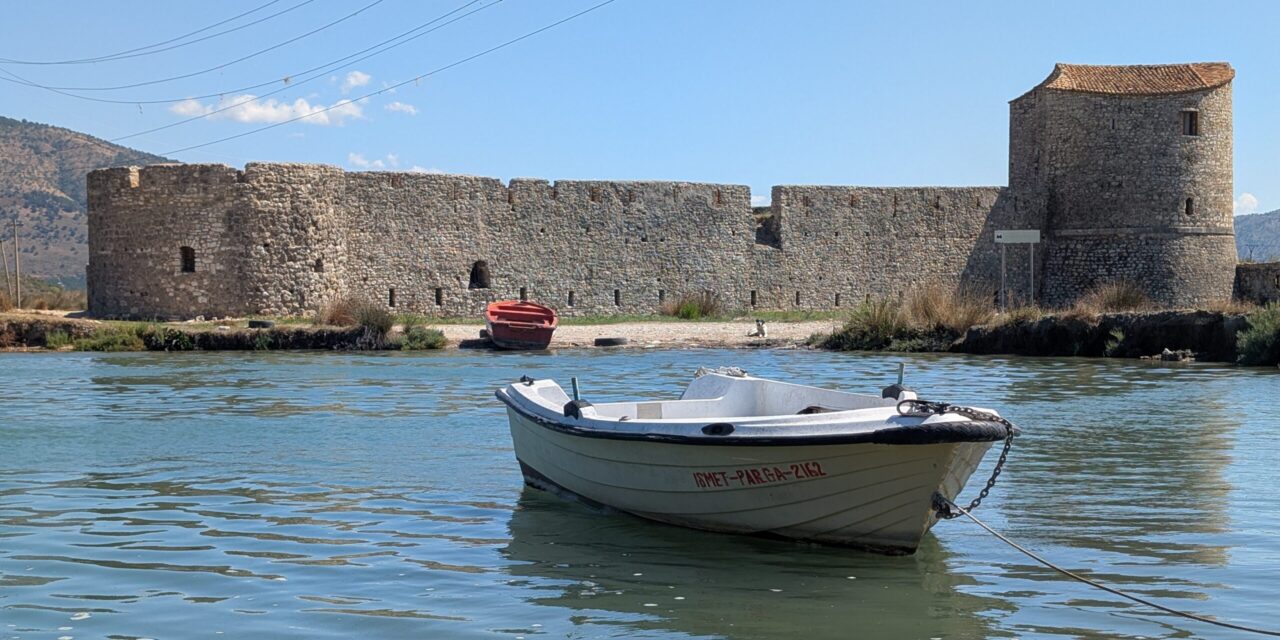
Ali Pasha Castle at the ferry crossing to Butrint
Butrint is strategically located in the eastern part of the Strait of Corfu in the extreme south of the country. It sprawls across a peninsula surrounded by Lake Butrint and the Vivari Channel. The channel connects the lake to the Ionian Sea through a narrow sandy bar. This is where we crossed on a pulley powered small ferry. The natural channel flows in both directions every six hours, as the tide changes. This mix of salt and fresh river water is ideal for mussels to thrive hence the many small ‘mussel farms’ we could see from our ride round the peninsula.
See below for a short video of my walk round the ancient archaeological site
A short history of Butrint, a UNESCO World Heritage site
Butrint is an ancient port city on the Adriatic which dates back to the 8th century B.C. and was founded, according to ancient mythology, by the exiles from the fall of the city of Troy.
The excavations of the site indicate that by the 4th century B.C. the settlement was surrounded by defensive walls and during the Hellenistic period was developed into a cultural center with a chapel dedicated to Asclepius, the god of medicine.
In 228 B.C. Butrint fell under the Roman Empire and became a province of Macedonia. During this period the city expanded with modification of the theatre and its surrounds to a more typical Roman style, various temples, forums, fountains, thermal baths, private villas and a new water supply plus a bridge linking the two banks of the Vivari canal.
In the 5th/6th centuries it became an Episcopal residence with impressive early Christian architecture including a large baptistery and Basilica in addition to another 8 churches!
By the 18 hundreds it had reverted to a small fishing village and Ali Pasha, who ruled Albania for the Ottoman Empire built a fortress to deter French attacks from Corfu. The Ottoman Empire ruled Albania until the Albanian Declaration of Independence in 1912.